Have a query or want to arrange for sales assistance?
Contact us now by filling out the form or drop us an email. And we’ll get back to you as soon as possible.

Home /
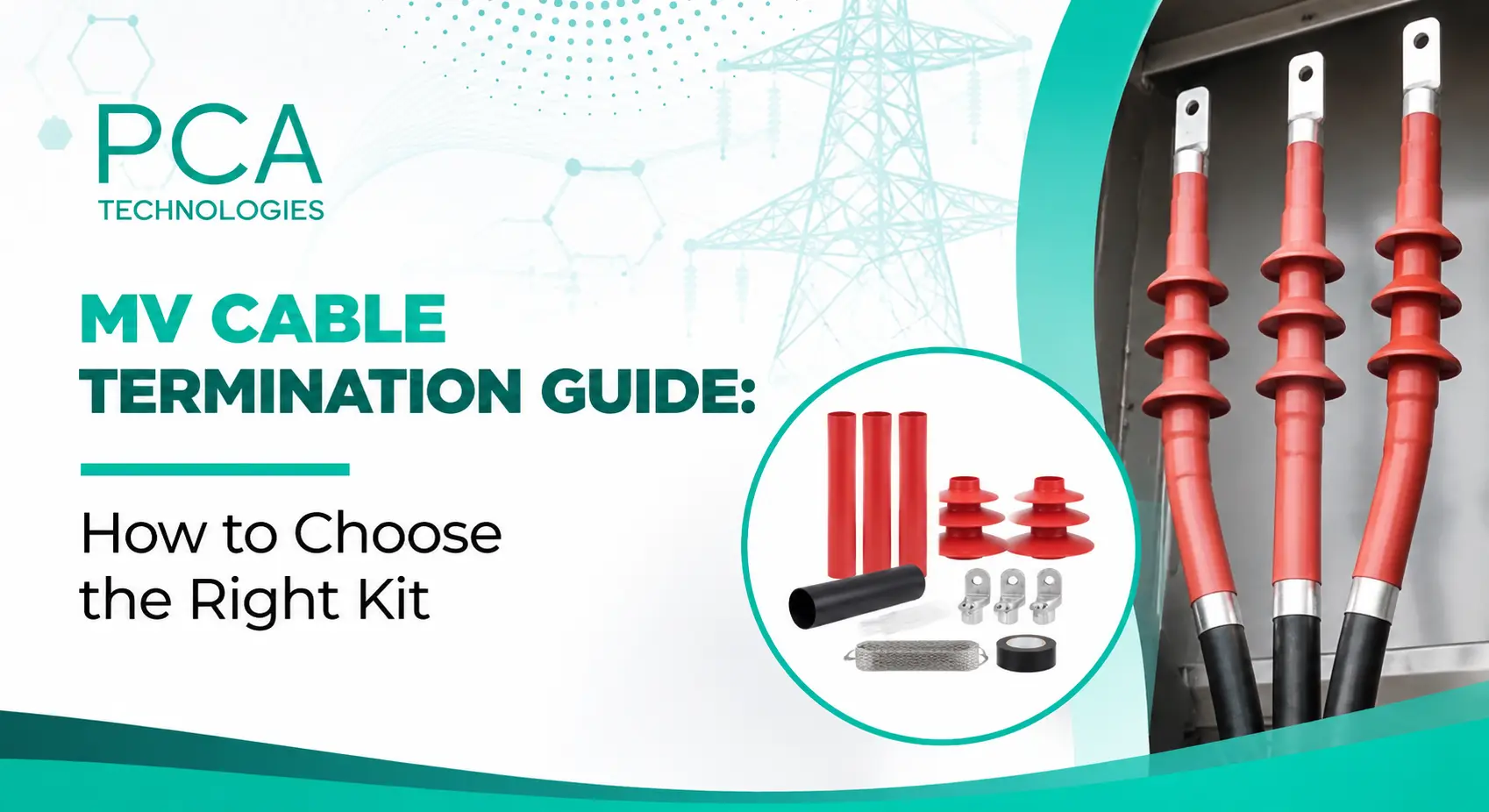
Selecting the right medium-voltage (MV) cable termination kit is essential for safe, reliable electrical connections in power distribution networks. Whether you’re working on an 11kV industrial installation, a 33kV substation, or a renewable energy project, the termination system must be compatible with the cable, electrical equipment, and operating environment.
A properly selected termination kit helps control electrical stress, maintain insulation integrity, protect against environmental conditions, and support reliable cable performance. An unsuitable or incorrectly installed kit, however, can contribute to partial discharge, insulation deterioration, tracking, overheating, and unexpected electrical failures.
This MV cable termination guide explains the different types of termination kits, how they work, and the technical factors engineers, EPC contractors, utilities, and procurement teams should evaluate before purchasing.
It also explores suitable termination solutions from PCA Technologies, including Nexans MONOi, TTGI3, and TTGE3 heat shrink cable termination systems.
What Is an MV Cable Termination Kit?
An MV cable termination kit is a specialized assembly used to connect the end of a medium-voltage power cable to electrical equipment such as transformers, switchgear, busbars, and distribution systems.
Unlike a basic conductor connection, an MV termination must manage the electrical field around the cable insulation, particularly where the cable’s conductive screen is removed.
A typical termination assembly may include:
The exact components depend on the termination design, voltage class, cable construction, and installation environment.
Learn more about the role of insulation and electrical stress management in our technical guide to heat shrink tubes for cable accessories.
Why Is Proper MV Cable Termination Important?
Medium-voltage cable insulation is designed to maintain a controlled electrical field along the cable length. When the cable is prepared for termination, the insulation screen is cut back, changing the electrical field distribution.
Without appropriate stress control, this transition can produce localized electrical stress that may contribute to insulation damage.
A suitable MV termination kit performs several essential functions.
Stress control components help redistribute the electric field at the cable screen cutback. This reduces localized electrical stress and helps prevent premature insulation failure.
The termination system provides insulation around exposed sections of the cable and supports the required electrical clearances.
Moisture, dust, and contaminants can affect termination performance. Suitable sealing components help protect vulnerable cable interfaces and connection points.
Anti-tracking materials help reduce the risk of conductive paths developing across insulation surfaces, particularly in polluted or humid environments.
Correctly selected conductor lugs and connectors help maintain electrical continuity and reduce the risk of overheating caused by poor contact.
Because these functions work together, selecting a termination kit solely by voltage or conductor size is insufficient.
Types of MV Cable Termination Kits
MV cable terminations can be classified according to their installation environment and insulation technology.
Indoor cable termination kits are designed for protected electrical environments such as switchgear rooms, transformer enclosures, distribution panels, and indoor substations.
They are typically used where direct exposure to rain, sunlight, and external pollution is limited.
Indoor terminations must still provide effective insulation, electrical stress control, and sealing.
Nexans MONOi Heat Shrink Indoor Termination
The Nexans MONOi heat shrink indoor termination available from PCA Technologies uses an integrated tube design with an inner stress control layer and an outer anti-tracking layer.
Its compact construction makes it particularly useful in applications where installation space is limited, including switchgear cable boxes.
Key characteristics include:
The correct MONOi variant must be selected using the manufacturer’s voltage, dimensional, and cable construction specifications.
Nexans TTGI3 Heat Shrink Indoor Termination
The TTGI3 heat shrink indoor termination kit is designed for compatible polymeric-insulated, armoured or unarmoured cables with copper wire or tape screens.
Its design uses stress control tubing and mastic to manage electrical stress around the cable screen cutback.
TTGI3 kits also incorporate insulation, anti-tracking, breakout, and sealing components according to the selected configuration.
These terminations are suitable for specified indoor applications involving transformers, switchgear, and busbar connections.
Outdoor MV cable termination kits are designed for installations exposed to environmental conditions such as rain, sunlight, humidity, pollution, and temperature variations.
These terminations require suitable weather-resistant insulation systems and adequate creepage distance to support reliable operation.
Nexans TTGE3 Heat Shrink Outdoor Termination
The TTGE3 heat shrink outdoor termination kit is designed for compatible medium-voltage polymeric-insulated cables.
Its construction includes electrical stress control components, anti-tracking materials, sealing systems, and rain sheds.
Rain sheds help increase creepage distance along the termination surface, supporting insulation performance under appropriate environmental conditions.
Typical applications include outdoor transformers, electrical substations, and industrial power distribution equipment.
Why Outdoor Terminations Need Additional Protection
Outdoor installations can expose insulation surfaces to moisture and pollution, increasing the possibility of leakage currents and surface tracking.
The required creepage distance depends on the electrical insulation design, voltage rating, and environmental conditions.
Specialized heat shrink rain sheds can be used in compatible termination designs to increase surface creepage distance.
However, rain sheds should only be installed as specified by the approved termination design. Adding components independently does not automatically improve a termination’s electrical performance.
Indoor vs Outdoor MV Cable Termination Kits
Feature | Indoor termination | Outdoor termination |
Installation environment | Protected electrical spaces | Exposed outdoor locations |
Electrical stress control | Required | Required |
Weather resistance | Based on protected installation conditions | Designed for specified outdoor exposure |
Anti-tracking protection | According to product design | Typically essential for exposed conditions |
Creepage distance | Based on insulation and equipment requirements | Accounts for environmental pollution and exposure |
Typical applications | Switchgear rooms, indoor transformers | Outdoor substations, transformers, distribution systems |
PCA product examples | MONOi, TTGI3 | TTGE3, MONOe |
An indoor termination should not be substituted for an outdoor termination unless the manufacturer explicitly approves the application.
Heat Shrink vs Cold Shrink MV Cable Terminations
Another important decision is choosing between heat shrink and cold shrink termination technology.
Both technologies can provide reliable medium-voltage insulation when properly designed, specified, and installed.
Heat Shrink Cable Termination Kits
Heat shrink termination kits use cross-linked polymer components that recover around the prepared cable when controlled heat is applied.
The recovery process helps position insulation, stress control, and sealing components around the cable assembly.
Advantages of heat shrink terminations:
Installation requires the correct heating equipment, adequate working space, and personnel trained in the manufacturer’s procedure.
Cold Shrink Cable Termination Kits
Cold shrink termination kits use pre-expanded elastomeric components supported by removable cores.
During installation, the support is removed, allowing the material to contract around the prepared cable.
Advantages of cold shrink terminations:
Cold shrink kits still require accurate cable preparation, correct positioning, compatible dimensions, and approved connection procedures.
Heat Shrink vs Cold Shrink Comparison
Selection factor | Heat shrink | Cold shrink |
Installation method | Controlled heating | Removal of expansion support |
External heat | Required for recovery | Not required for recovery |
Typical materials | Cross-linked polymer systems | Pre-expanded elastomeric systems |
Tools | Heating and cable preparation tools | Cable preparation and connection tools |
Installation considerations | Heat control, recovery, sealing | Positioning, recovery range, sealing |
Suitable environments | As specified by product approval | As specified by product approval |
Main selection basis | Compatibility, performance, installation conditions | Compatibility, performance, installation conditions |
Neither technology is automatically superior for every installation.
The best choice depends on cable compatibility, environmental conditions, installer capability, project standards, and product approval.
For a broader understanding of termination technology, explore PCA Technologies’ guide to different types of MV cable termination kits.
How to Select the Right MV Cable Termination Kit: 8 Key Factors
Choosing the correct MV cable termination kit begins with understanding the complete cable system rather than selecting a product based only on its nominal voltage.
The termination kit must be approved for the cable’s rated voltage and the maximum operating voltage of the electrical system.
Common MV applications include 11kV, 22kV, and 33kV networks.
For example, depending on the cable and earthing arrangement, specifications may identify voltage classes such as:
Nominal system voltage | Example cable voltage designation |
11kV | 6.35/11 (12) kV |
22kV | 12.7/22 (24) kV |
33kV | 19/33 (36) kV |
These are examples, not universal substitutions. The correct designation depends on the network, cable specification, and applicable standards.
When reviewing termination kits, check the full U₀/U (Uₘ) rating. The nominal system voltage alone does not establish accessory compatibility.
Cable termination kits are designed for specific cable constructions.
Before selection, confirm the insulation material, such as XLPE or EPR, and measure the insulation diameter according to the manufacturer’s instructions.
Two cables with the same conductor cross-sectional area may have different insulation dimensions.
A termination that does not correctly fit the cable can compromise stress control and sealing.
Confirm whether the cable uses copper or aluminium conductors and identify its cross-sectional area in mm².
The termination kit and conductor lug must be compatible with the selected conductor size, shape, and material.
For example, a 240 mm² aluminium conductor may require a different connector arrangement from a 240 mm² copper conductor.
Buyers should also verify compatibility with the termination body’s internal dimensions.
For further guidance, read Mechanical Lugs vs Compression Lugs: How to Choose the Right Connection.
MV power cables may be single-core or three-core, armoured or unarmoured, and fitted with copper wire or tape screens.
These construction differences affect the termination arrangement, screen connections, earthing components, and cable breakout requirements.
Always provide the complete cable specification to the supplier.
A termination installed inside a protected switchgear room faces different conditions from one installed at an outdoor transformer.
For outdoor applications, evaluate pollution, humidity, UV exposure, precipitation, altitude, and required insulation clearances.
For indoor installations, consider enclosure dimensions, ventilation, operating conditions, and available working space.
The termination must fit the intended electrical equipment.
Check the cable entry arrangement, available clearance, terminal palm dimensions, stud-hole size, and connection orientation.
For enclosed switchgear and transformers, confirm whether a conventional termination or a screened separable connector is required.
For example, equipment with a standardized plug-in bushing interface may require a compatible EUROMOLD separable connector system rather than an exposed lug-type termination.
For relevant medium-voltage cable accessories, IEC 60502-4:2023 specifies type-testing requirements for accessories within its defined voltage range.
Other standards may apply depending on voltage class, product construction, and project requirements, including IEC 61442, IEC 60840, and relevant Indian or utility specifications.
Before purchasing, request the appropriate technical datasheet, test reports, installation instructions, and applicable compliance documentation.
Termination performance depends on both product quality and installation workmanship.
Consider the required tools, cable preparation process, training requirements, and inspection procedures.
For critical projects, technical support from an experienced cable accessory supplier can help reduce avoidable specification and installation problems.
11kV vs 33kV Cable Termination Kits: What Changes?
An 11kV cable termination kit and a 33kV termination kit perform similar basic functions, but their electrical insulation requirements differ.
The higher voltage class generally requires different insulation design, stress control characteristics, clearances, and creepage requirements.
Parameter | 11kV application | 33kV application |
Nominal voltage | 11kV | 33kV |
Example maximum system voltage | 12kV | 36kV |
Electrical stress control | Required | Required, with higher-voltage design requirements |
Insulation coordination | Based on applicable 11kV system specification | Based on applicable 33kV system specification |
Termination dimensions | Product-specific | Product-specific |
Indoor/outdoor versions | Available | Available |
Cable compatibility | Must be verified | Must be verified |
A termination designed and tested for a higher voltage class should not automatically be treated as interchangeable with one intended for a lower-voltage cable.
Check the manufacturer’s approved application range, including insulation dimensions and relevant electrical stress conditions.
MV Cable Termination Selection Checklist for Engineers and Buyers
Use the following checklist when preparing a technical enquiry or purchase specification.
Selection parameter | Information required |
Nominal system voltage | 11kV, 22kV, 33kV, or other |
Cable rated voltage | U₀/U (Uₘ) designation |
Cable insulation | XLPE, EPR, or other |
Conductor material | Copper or aluminium |
Conductor size | Cross-sectional area in mm² |
Cable configuration | Single-core or three-core |
Cable screen | Copper wire, copper tape, or other |
Cable armour | Armoured or unarmoured |
Insulation diameter | Actual measured or specified range |
Installation location | Indoor or outdoor |
Equipment connection | Transformer, switchgear, busbar, or other |
Termination technology | Heat shrink, cold shrink, or pre-moulded |
Compliance documentation | Applicable standards and test evidence |
Providing these details helps suppliers recommend compatible products and can reduce delays caused by incorrect kit selection.
Common MV Cable Termination Mistakes to Avoid
Even well-engineered cable networks can experience problems when cable terminations are incorrectly specified or installed.
Selecting a Kit Based Only on Voltage
Voltage compatibility is necessary but does not confirm suitability for the cable insulation diameter, conductor dimensions, screen construction, or equipment interface.
Incorrect Cable Preparation
Damage to the insulation, incorrect screen cutback dimensions, or remaining semiconductive material can affect electrical stress distribution.
Cable preparation must follow the exact termination manufacturer’s instructions.
Poor Moisture Sealing
Incomplete sealing can allow environmental contaminants to enter vulnerable areas of the termination.
This is particularly important in outdoor and humid locations.
Incorrect Lug Selection or Installation
Using an incompatible lug, incorrect crimping die, or improper mechanical tightening procedure can create connection problems.
Insufficient Installation Clearances
A termination may be electrically compatible with a cable but unsuitable for the space available inside the equipment enclosure.
Check physical dimensions and electrical clearances before ordering.
Inadequate Inspection and Testing
Inspection and commissioning tests should follow the approved project procedure and applicable standards.
A visual inspection alone cannot establish that every electrical requirement has been satisfied.
For a deeper explanation of these reliability issues, read Key Factors That Influence the Performance of MV Cable Joints and Terminations.
Applications of MV Cable Termination Kits
Medium-voltage cable termination systems are used wherever power cables connect to distribution and control equipment.
Power Distribution and Utility Substations
Utilities use MV terminations to connect feeders, transformers, and electrical distribution equipment.
Industrial Manufacturing Plants
Factories require reliable terminations for distribution transformers, switchgear, motors, and industrial power networks.
Solar and Wind Energy Projects
Renewable energy installations use MV cable accessories for transformer connections, collection systems, and power distribution infrastructure.
Data Centres
Data centres rely on carefully engineered electrical distribution systems where connection reliability and maintainability are important.
Infrastructure and Commercial Projects
Metro systems, airports, industrial parks, and commercial facilities use medium-voltage networks to distribute power across multiple buildings and equipment installations.
The appropriate termination design must reflect each project’s operating conditions, equipment requirements, and maintenance strategy.
Why Choose PCA Technologies for MV Cable Termination Kits?
PCA Technologies supplies engineered power cable accessories for low-voltage, medium-voltage, and high-voltage electrical networks.
With more than 40 years of industry expertise, the company supports utilities, EPC contractors, electrical equipment manufacturers, and industrial customers.
Its cable termination product range includes Nexans heat shrink indoor and outdoor systems such as MONOi, MONOe, TTGI3, and TTGE3, along with supporting cable insulation and connection accessories.
PCA Technologies also provides technical services involving cable systems, installation, and training.
Explore the PCA Technologies product range to find suitable cable accessories for your project.
Request Technical Support for Your MV Cable Termination Project
Choosing between an 11kV and 33kV termination, an indoor and outdoor design, or different termination technologies requires accurate technical specifications.
PCA Technologies can assist buyers in reviewing cable and equipment requirements to identify suitable product options.
Contact PCA Technologies for MV Cable Termination Kits and Technical Assistance
What is an MV cable termination kit?
An MV cable termination kit is an assembly used to connect the end of a medium-voltage power cable to electrical equipment. It provides electrical stress control, insulation, environmental protection, and a suitable conductor connection.
What is the difference between indoor and outdoor cable termination kits?
Indoor terminations are designed for protected environments, while outdoor terminations must accommodate specified environmental exposure. Outdoor systems typically require suitable weather-resistant insulation and creepage distance.
Is heat shrink or cold shrink better for MV cable termination?
Both technologies can provide reliable performance when correctly selected and installed. Heat shrink systems require controlled heating, while cold shrink systems recover without external heat. Selection depends on product compatibility, installation conditions, and project specifications.
Can I use an 11kV termination kit for a 33kV cable?
No. An 11kV-rated termination kit should not be used for a 33kV application unless the manufacturer explicitly specifies and approves that exact application, which should not be assumed. The required voltage rating and cable compatibility must be verified.
What information should I provide when requesting an MV termination quotation?
Provide the system voltage, cable voltage designation, conductor material and size, insulation material and diameter, number of cores, cable screen and armour details, installation environment, and equipment connection requirements.
Click here
Click here
Click here
Click here
Click here
Click here
Click here
Click here