
Have a query or want to arrange for sales assistance?
Contact us now by filling out the form or drop us an email. And we’ll get back to you as soon as possible.
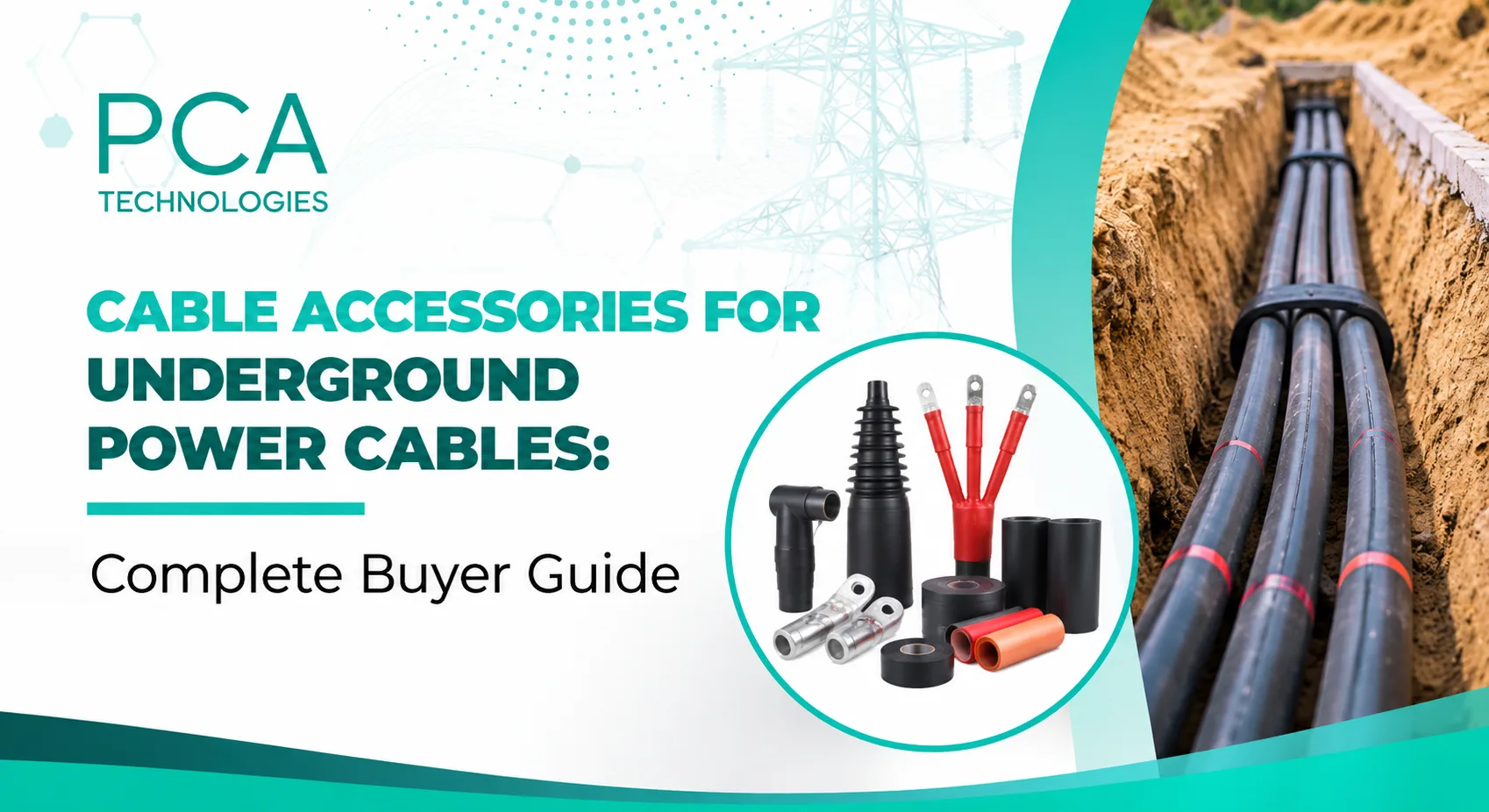
Underground power cables are essential to modern electrical distribution networks, supplying electricity to industrial facilities, urban infrastructure, substations, renewable energy installations, and commercial developments. Although underground cables offer protection from many external hazards, their performance depends heavily on the quality of the connections, joints, terminations, and protective components used throughout the network.
Choosing the right cable accessories for underground power cables is therefore just as important as selecting the cables themselves.
A poorly matched cable joint, incorrectly installed termination, or unsuitable connector can create electrical stress, overheating, insulation deterioration, or moisture-related failures. These problems can lead to costly repairs, unexpected outages, and reduced network reliability.
For utilities, EPC contractors, electrical consultants, and industrial project managers, understanding the different types of underground cable accessories helps ensure safer installations and more informed purchasing decisions.
This guide explains the essential accessories used in underground power cable systems, their applications, technical specifications, selection criteria, and common purchasing mistakes.
Cable accessories for underground power cables are specialized electrical components used to connect, terminate, insulate, protect, and maintain underground cable systems.
Their primary purpose is to preserve the electrical, mechanical, and environmental protection provided by the cable itself, particularly where the cable is joined, terminated, or connected to equipment.
These accessories are widely used in low-voltage (LV), medium-voltage (MV), and high-voltage (HV) electrical networks.
The most common underground power cable accessories include:
Cable jointing kits for connecting cable sections.
Cable termination kits for connecting cables to electrical equipment.
Separable connectors for switchgear and transformer connections.
Mechanical connectors and compression lugs for conductor connections.
Heat shrink and cold shrink insulation systems.
Link boxes for metallic sheath bonding and earthing arrangements.
Cable sealing, screening, and protective components.
Each accessory performs a specific function and must be compatible with the electrical characteristics, construction, and installation environment of the cable.
Explore the range of power cable accessories and electrical components available from PCA Technologies.
Different accessories are required at different points in an underground distribution network. Understanding their functions helps buyers select the appropriate products for each installation.
Cable jointing kits are used to connect two or more power cable sections while maintaining conductor continuity, insulation integrity, electrical screening, and environmental protection.
Underground cable joints are especially important because they are often installed in trenches, cable pits, or other locations where repairs can be difficult and expensive.
Common types include:
Heat shrink jointing kits use specially engineered polymer components that recover around the cable when heated.
Depending on the kit design, they restore insulation, manage electrical stress, reconstruct the cable screen, and provide environmental sealing.
Key advantages:
Suitable for many LV and MV cable applications.
Provides insulation and moisture protection when correctly installed.
Available for different conductor sizes and cable constructions.
Can accommodate a range of installation configurations.
PCA Technologies offers solutions such as Nexans heat shrink MV straight-through joints for suitable medium-voltage cable applications.
Cold shrink systems use pre-expanded elastomeric components that contract around the cable after a supporting core is removed.
Unlike heat shrink accessories, they do not require direct flame heating to recover the insulation body.
Cold shrink systems can be useful in installations where flame-based heating is restricted or difficult. However, suitability depends on the cable dimensions, voltage rating, installation environment, and manufacturer’s product specifications.
A straight-through joint connects two compatible cable sections in a continuous electrical circuit.
A transition joint connects cables with different constructions or insulation systems. Such applications may require specialized joint designs and additional compatibility checks.
Buyer’s tip: Never select a cable joint based only on conductor size. Verify the cable’s rated voltage, insulation diameter, conductor material, metallic screen arrangement, and overall construction.
Cable termination kits provide a reliable connection between the end of a power cable and equipment such as transformers, switchgear, distribution panels, and substations.
At the termination point, the cable’s insulation and screen arrangement are interrupted. This creates a need for carefully designed electrical stress control and insulation protection.
Two common categories are:
Indoor termination kits are intended for use inside protected electrical environments, including switchgear rooms, substations, and industrial electrical installations.
They are designed to manage electrical stress, restore insulation, and support reliable equipment connections.
PCA Technologies’ heat shrink termination range includes indoor solutions such as MONOi and TTGI3 for compatible applications.
Outdoor cable terminations must withstand additional environmental conditions, including rain, humidity, pollution, ultraviolet exposure, and temperature variation.
These systems commonly incorporate weather-resistant insulation, anti-tracking materials, and rain sheds where required by the design.
PCA Technologies offers outdoor heat shrink termination solutions such as MONOe and TTGE3.
To understand how these systems work, read our technical guide to heat shrink tubes used in cable accessories.
Separable connectors provide insulated cable connections to compatible electrical equipment, particularly in medium-voltage distribution systems.
They are frequently used with:
Ring Main Units (RMUs).
Gas-insulated switchgear (GIS).
Distribution transformers.
Compact substations.
Underground distribution networks.
Renewable energy installations.
EUROMOLD separable connector systems are available in different designs, voltage classes, current ratings, and equipment interface configurations.
Depending on the product, connectors may use screened or unscreened construction and plug-in or bolted connection arrangements.
Important selection factors include:
Rated voltage and continuous current.
Equipment bushing interface.
Cable conductor size and material.
Cable insulation diameter.
Screened or unscreened requirements.
Short-circuit performance and earthing provisions.
A connector should never be assumed interchangeable with another model merely because both have similar voltage ratings. The equipment interface and full product specifications must match.
Conductors must be connected securely inside cable joints and at termination points.
Two widely used connection methods are mechanical connectors and compression connectors.
Mechanical connectors use bolts or screws to establish electrical contact. Certain designs use shear-head bolts to help achieve the specified tightening arrangement.
Compression connectors use approved crimping tools and dies to compress the connector barrel around the conductor.
Both methods can provide reliable performance when correctly selected and installed.
Selection factor | Mechanical connectors | Compression connectors |
|---|---|---|
Installation method | Bolts or screws | Crimping |
Main tooling | Manufacturer-specified tightening tools | Approved crimping tools and dies |
Size flexibility | Some models accommodate a conductor size range | Typically selected for specific conductor sizes |
Main consideration | Correct tightening and conductor compatibility | Correct die, tool, and crimping procedure |
The decision should be based on conductor material, electrical ratings, project specifications, available tooling, and manufacturer’s installation requirements.
For a more detailed comparison, read Mechanical Lugs vs Compression Lugs.
In certain underground power cable systems, particularly single-core cable installations, metallic sheaths and screens require a carefully designed bonding and earthing arrangement.
Link boxes provide accessible connection points for these arrangements.
Depending on the cable system design, link boxes may support:
Single-point bonding.
Both-end bonding.
Cross-bonding arrangements.
Sheath testing and maintenance.
Sheath voltage limiter (SVL) connections.
Sheath voltage limiters may be used to protect cable sheath insulation against specified transient overvoltages.
However, SVL selection and placement require electrical engineering calculations. Not every cable system needs the same bonding arrangement or type of link box.
The appropriate configuration depends on cable length, layout, induced sheath voltages, fault conditions, and the overall system design.
In addition to major connection accessories, underground cable systems require supplementary components that maintain insulation integrity and protect against environmental damage.
These may include:
Heat shrink insulating tubes.
Stress control tubing and mastic.
Semiconductive screening components.
Self-amalgamating tapes.
Copper braids and earthing components.
Cable entry seals.
Protective sleeves and reinforcement materials.
Moisture protection is especially important in underground environments. Water ingress at joints and cable entry points can contribute to insulation deterioration and electrical faults.
For example, cable entry seals help protect cable entries into suitable enclosures against moisture and other environmental contaminants.
The sealing system should always be selected for the actual installation conditions, rather than relying on a general waterproof claim.
For more information about cable sheath bonding, see our guide on Link Box with SVL vs Link Box Without SVL.
Selecting underground cable accessories requires more than comparing prices or product descriptions. The accessories must be compatible with the complete electrical system.
The accessory’s voltage rating must be suitable for the cable and electrical network.
For example, an accessory designed for an 11 kV system should not automatically be assumed suitable for a 33 kV installation.
When selecting medium-voltage accessories, check the manufacturer’s rated voltage designation, including U₀/U (Uₘ), rather than relying solely on the system’s nominal voltage.
Cable accessories are manufactured for specific cable constructions and dimensional ranges.
Before selecting a product, confirm:
Conductor material: copper or aluminium.
Conductor cross-sectional area in mm².
Single-core or three-core cable construction.
Insulation material, such as XLPE or EPR.
Cable insulation diameter.
Metallic screen and armour arrangement.
Overall cable sheath dimensions.
Even when two cables have the same conductor size and voltage rating, their insulation dimensions may differ.
This makes product compatibility checks essential.
Underground accessories may be exposed to moisture, soil contaminants, mechanical stress, and temperature changes.
Consider whether the installation involves direct burial, a cable trench, an underground chamber, or a protected enclosure.
Check that the selected product is approved for the actual installation environment.
An accessory suitable for an indoor cable box is not necessarily appropriate for direct burial.
The selected accessories must withstand normal operating conditions and the specified fault conditions.
Important parameters include continuous current, conductor operating temperature, short-circuit withstand capability, insulation performance, and electrical stress control.
For joints and connectors, the entire assembly must be evaluated rather than relying on the rating of an individual component.
Different accessory technologies require different installation tools, preparation methods, and installer competencies.
Before purchasing, confirm whether the system requires heat application, crimping tools, torque-controlled tightening, specialist cable preparation tools, or additional installation equipment.
Clear installation instructions and competent technicians are important for achieving the expected performance.
For medium-voltage cable accessories, relevant standards may include:
IEC 60502-2: Requirements for extruded-insulation power cables in the applicable medium-voltage range.
IEC 60502-4:2023: Type-testing requirements for specified medium-voltage cable accessories.
IEC 61442: Test methods for specified cable accessories.
IEC 61238-1-3: Requirements for applicable compression and mechanical connectors used on power cables.
The applicable standard depends on the product, voltage range, and project specification. The IEC 60502-4:2023 standard addresses type testing for accessories used with specified medium-voltage power cables.
Ask suppliers for the relevant product datasheets, type-test documentation, installation instructions, and technical compliance information.
Before placing an order, procurement and engineering teams can use the following checklist to avoid specification errors.
Parameter | Information to confirm |
|---|---|
System voltage | Nominal voltage and U₀/U (Uₘ) rating |
Cable construction | Single-core or three-core |
Conductor | Copper or aluminium |
Conductor size | Cross-sectional area in mm² |
Insulation | XLPE, EPR, or other type |
Cable dimensions | Insulation diameter and sheath dimensions |
Accessory type | Joint, termination, connector, or link box |
Installation location | Direct burial, trench, chamber, indoor or outdoor |
Electrical performance | Current rating and fault withstand |
Equipment interface | Bushing type and connection dimensions |
Documentation | Datasheets, test reports, installation instructions |
Providing these details during the initial enquiry helps suppliers identify suitable products and reduces the risk of ordering incompatible accessories.
Several avoidable purchasing and installation mistakes can affect underground cable reliability.
A lower initial product price does not necessarily result in lower overall project costs.
The total cost should also account for compatibility, installation requirements, testing, maintenance, and the potential expense of future cable failures.
A kit may support the correct conductor size but still be unsuitable for the actual insulation diameter.
Always verify the manufacturer’s approved dimensional range.
Underground installations frequently involve moisture exposure. Selecting sealing materials without checking their suitability can compromise the protective system.
Separable connectors must match the equipment’s bushing interface and electrical ratings.
An incorrect interface can prevent proper installation or create an unsafe connection.
Even a correctly specified accessory may fail if the cable is poorly prepared, components are damaged, or installation instructions are not followed.
Personnel should use approved procedures and complete the inspections and testing required by the project.
Underground cable accessories support a wide range of electrical infrastructure projects across India.
Electricity distribution companies use underground cable joints, terminations, and separable connectors to connect feeders, substations, and distribution equipment.
Manufacturing plants rely on underground cable networks to distribute electricity between substations, transformers, switchgear, and production facilities.
Solar and wind energy projects require suitable cable accessories for collection systems, transformer connections, and power evacuation infrastructure.
Underground cable systems are common in metro projects, airports, commercial campuses, industrial parks, and densely developed urban areas.
Data centres and other facilities requiring high electrical availability depend on properly engineered cable connections and maintenance practices to minimize outage risks.
Each application presents different electrical and environmental requirements, making accessory selection an important part of system engineering.
PCA Technologies provides engineered power cable accessories for LV, MV, and HV electrical networks.
With more than 40 years of industry expertise, the company supports electrical utilities, EPC contractors, infrastructure developers, and industrial customers with cable accessory products and technical solutions.
Its product portfolio includes heat shrink cable joints, indoor and outdoor terminations, EUROMOLD separable connector systems, electrical connection components, insulation materials, and link boxes.
Beyond product supply, PCA Technologies also offers technical services covering cable system auditing, design, installation, and training.
These services help project teams address product selection, application requirements, and installation challenges.
Explore our cable accessories services or contact PCA Technologies to discuss your technical requirements.
Looking for suitable cable jointing kits, terminations, or connectors for an underground power distribution project?
PCA Technologies can assist with product selection based on cable specifications, system voltage, equipment interfaces, and installation requirements.
Whether your project involves an industrial facility, utility distribution network, substation, or infrastructure development, selecting the correct accessories early can help reduce compatibility problems during installation.
Contact PCA Technologies for Product Selection and Technical Enquiries
Selecting the right cable accessories for underground power cables is essential for maintaining reliable electrical connections, insulation performance, and network safety.
Cable joints, terminations, separable connectors, link boxes, and protective components each serve a critical purpose within the underground cable system.
The most effective purchasing approach is to evaluate the complete application, including voltage rating, cable dimensions, conductor material, environmental conditions, equipment interfaces, and applicable technical standards.
Rather than selecting components individually without considering system compatibility, utilities, EPC contractors, and industrial buyers should work with experienced cable accessory suppliers who can support technical product selection.
PCA Technologies combines product knowledge, engineering experience, and cable system services to support underground power distribution requirements across India and international markets.
Planning an underground cable installation or upgrading an existing power network?
Get in touch with PCA Technologies to discuss your cable accessory requirements and identify suitable solutions for your project.
PCA Technologies – Power Cable Accessories and Engineering Specialists
PCA Technologies specializes in engineered cable accessories and solutions for low-voltage, medium-voltage, and high-voltage electrical networks. Backed by more than 40 years of industry expertise, the company supports utilities, EPC contractors, industrial facilities, and infrastructure projects with cable accessory products, engineering assistance, installation services, and technical training.
The main accessories include cable jointing kits, termination kits, separable connectors, mechanical connectors, compression lugs, insulation components, sealing materials, and link boxes. Each component supports a specific electrical connection, insulation, protection, or bonding function.
The best jointing kit depends on the system voltage, cable construction, conductor size, installation conditions, and project specifications. Both heat shrink and cold shrink systems can be suitable when the selected product is approved for the application.
Yes. Heat shrink cable joints specifically designed and approved for underground installation can be used in suitable buried cable systems. The joint must provide the required electrical insulation, screening, mechanical protection, and environmental sealing.
A cable joint connects two cable sections to maintain electrical continuity. A cable termination prepares the end of a cable for connection to electrical equipment while providing the necessary insulation, electrical stress control, and environmental protection.
Yes. Compatible EUROMOLD separable connector systems can be used to connect medium-voltage cables to equipment such as RMUs, transformers, and switchgear. Selection depends on the voltage rating, current rating, equipment interface, and cable dimensions.
Common preventive measures include selecting compatible accessories, following approved cable preparation and installation procedures, controlling moisture ingress, using the correct connection tools, and conducting appropriate inspection and testing before energization.
IEC 60502-4 and IEC 61442 address specified medium-voltage cable accessory testing, while relevant parts of IEC 61238-1 apply to compression and mechanical connectors. Project specifications may require additional national or utility standards.
PCA Technologies supplies power cable accessories for utility, industrial, and infrastructure projects in India. Buyers can explore its product portfolio and contact the company for application-specific product recommendations.
Contact us now by filling out the form or drop us an email. And we’ll get back to you as soon as possible.
© 2026 PCA Technologies Private Limited. All rights reserved.