
Have a query or want to arrange for sales assistance?
Contact us now by filling out the form or drop us an email. And we’ll get back to you as soon as possible.
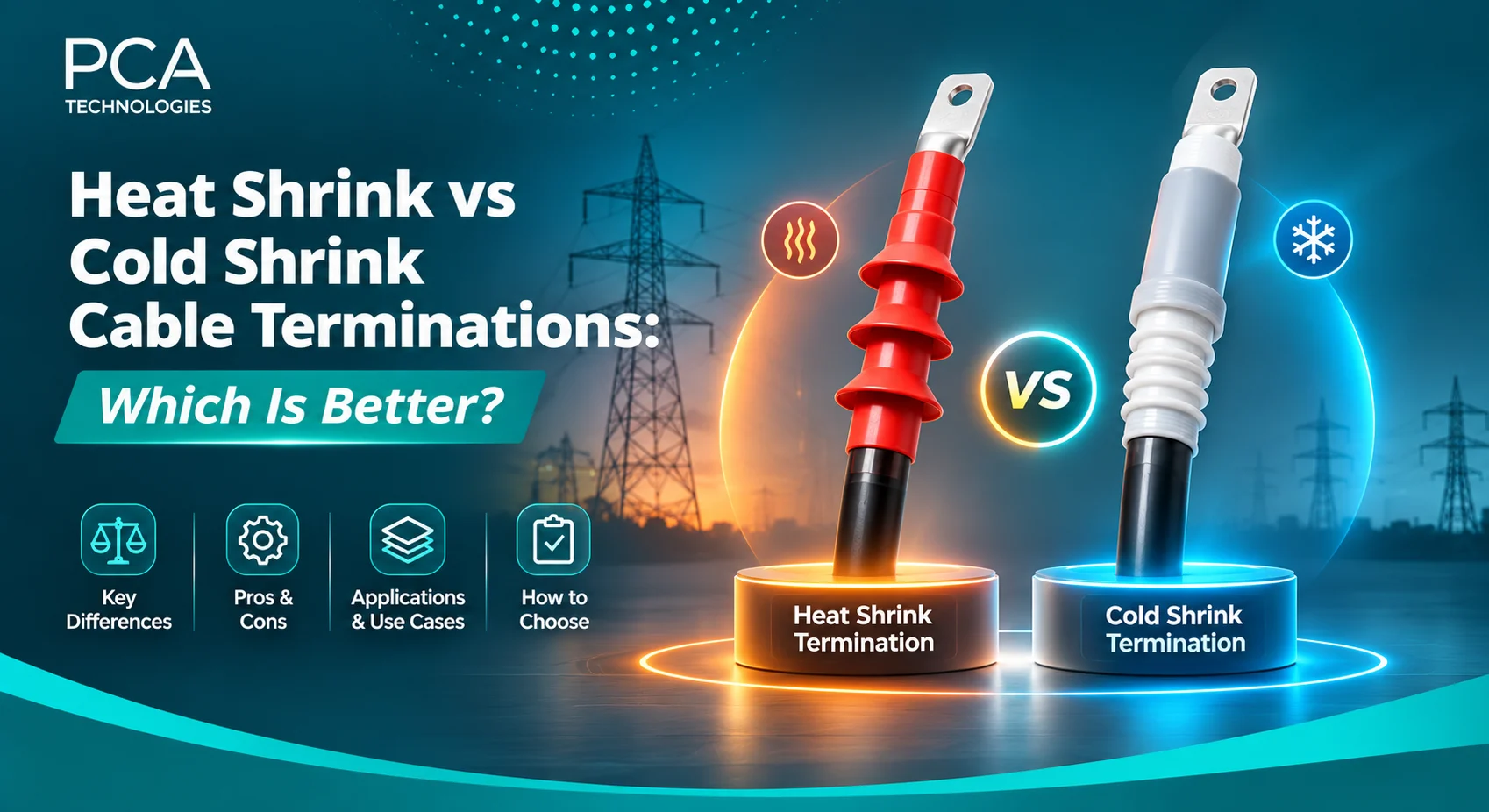
Choosing between heat shrink vs cold shrink cable terminations is an important decision for engineers, utilities, EPC contractors, and industrial electrical installers. Both technologies are designed to provide electrical insulation, stress control, and environmental protection at cable termination points, but they differ significantly in installation methods, materials, and application requirements.
Which is better? Heat shrink cable terminations are often a practical choice for projects with trained installers, suitable heating equipment, and established installation procedures. Cold shrink terminations are particularly useful where external heating is restricted, installation access is limited, or faster component recovery is desirable.
However, neither technology is universally superior. The best termination depends on cable voltage, insulation dimensions, environmental conditions, equipment connections, and product specifications.
This guide compares both technologies to help you select the right termination system for your electrical network.
A heat shrink cable termination uses specially engineered polymer components that contract around a prepared power cable when controlled heat is applied.
The process creates a close-fitting insulation system around the cable, helping manage electrical stress and protect exposed interfaces against moisture and contaminants.
Heat shrink termination kits typically contain:
Stress control tubing and mastic.
Anti-tracking insulation tubing.
Sealing materials.
Cable breakout components.
Earthing accessories.
Rain sheds for applications requiring additional creepage distance.
Heat shrink terminations are widely used in medium-voltage distribution networks, industrial facilities, transformers, and substations.
PCA Technologies offers Nexans products such as the MONOi heat shrink indoor termination and TTGI3 indoor termination kit for compatible cable applications.
Broad application range: Available for various cable constructions, conductor sizes, and voltage classes.
Reliable insulation: Properly recovered components provide electrical insulation and stress control.
Environmental sealing: Compatible mastics and sealing materials help protect against moisture ingress.
Established technology: Widely used in industrial and utility power distribution systems.
Product flexibility: Available in indoor and outdoor configurations, including compact designs.
Heat shrink technology requires external heating equipment and careful temperature control.
Uneven or excessive heating can cause incomplete recovery, wrinkles, component damage, or inadequate sealing. Installers must follow the manufacturer’s instructions and use appropriate tools.
For a detailed explanation, read PCA Technologies’ technical guide to heat shrink tubes for cable accessories.
A cold shrink cable termination uses a factory-expanded elastomeric component, commonly made from silicone rubber or EPDM, mounted on a removable supporting core.
During installation, the technician positions the component over the prepared cable and removes the support. The elastic material then contracts around the cable without external heating.
Cold shrink technology provides insulation, electrical stress control, and sealing through a pre-engineered design.
According to 3M’s technical explanation of cold shrink technology, the elastic properties of cold shrink materials allow them to maintain radial pressure around compatible cable surfaces.
3M US+1
No external heat required: Useful in locations where flame-based heating is restricted.
Simplified component installation: The termination body recovers by removing its supporting core.
Consistent radial pressure: Elastomeric materials can maintain contact pressure over their approved operating range.
Adaptability: Suitable designs can accommodate specified cable diameter variations.
Reduced heating-related risks: Eliminates overheating and flame exposure during component recovery.
Cold shrink kits can have higher upfront material costs in some product ranges, although actual pricing depends on the manufacturer and specification.
The components must also be correctly matched to the cable’s insulation diameter and installation conditions. Incorrect positioning, improper cable preparation, or unsuitable sizing can still cause failures.
Cold shrink installation is not completely tool-free because cable preparation, conductor connections, and testing require suitable equipment.
The following comparison highlights the most important technical and practical differences.
Comparison factor | Heat shrink termination | Cold shrink termination |
|---|---|---|
Installation method | Controlled heating | Removal of supporting core |
External heat | Required | Not required for component recovery |
Material | Cross-linked polymer | Silicone rubber or EPDM |
Stress control | Engineered tubing, mastic or integrated layers | Engineered elastomeric stress control |
Sealing method | Recovery with specified sealants or adhesives | Elastic compression with designed seals |
Installation tools | Heating and cable preparation tools | Cable preparation and connection tools |
Installation time | Depends on heating and component design | Can be quicker for certain designs |
Flame-restricted locations | May be unsuitable | Often advantageous |
Outdoor applications | Approved outdoor kits available | Approved outdoor kits available |
Initial material cost | Product-dependent | Product-dependent; sometimes higher |
Long-term reliability | Depends on product suitability and workmanship | Depends on product suitability and workmanship |
Both technologies are capable of reliable performance when properly engineered, tested, and installed.
The correct choice depends on the operating environment and project requirements.
Indoor electrical installations require compact termination systems with appropriate insulation and electrical clearances.
Heat shrink products such as the Nexans MONOi are designed for compact indoor applications, including suitable switchgear cable boxes.
Cold shrink designs may also be appropriate when they meet the required dimensions, insulation ratings, and equipment compatibility.
Recommended approach: Compare the approved termination dimensions, voltage class, installation space, and manufacturer’s documentation.
Outdoor installations expose cable terminations to moisture, ultraviolet radiation, pollution, and temperature variations.
Both technologies can be suitable when the product is designed and approved for outdoor conditions.
For example, PCA Technologies supplies the Nexans TTGE3 heat shrink outdoor termination, incorporating stress control, anti-tracking components, sealing materials, and rain sheds.
PCA Technologies
Heat shrink rain sheds can provide additional creepage distance within compatible termination designs.
Recommended approach: Evaluate environmental exposure, required creepage distance, pollution severity, and the product’s outdoor rating.
Certain industrial environments restrict open flames or require special permits for hot work.
Cold shrink terminations can be advantageous because the termination body does not require external heating.
However, the installation must still comply with site safety procedures and any hazardous-area equipment requirements.
Solar parks, wind farms, industrial campuses, and infrastructure projects may require large numbers of medium-voltage cable terminations.
In these installations, procurement teams should compare material costs, installation labour, tools, cable compatibility, and project schedules.
Cold shrink systems may reduce certain installation steps, while suitable heat shrink systems can provide cost-effective solutions for standardized installations.
The best choice should be supported by a project-specific technical and commercial evaluation.
Before selecting either technology, engineers and procurement teams should verify the complete cable specification.
Confirm the cable’s rated voltage designation, commonly expressed as U₀/U (Uₘ).
For example, 11kV and 33kV networks may use different cable voltage classes and require correspondingly approved termination kits.
Never assume that a product is suitable based solely on its nominal voltage description.
Confirm:
Copper or aluminium conductor.
Conductor cross-sectional area.
Single-core or three-core design.
XLPE, EPR, or other insulation.
Diameter over insulation.
Metallic screen and armour arrangement.
These parameters determine whether the termination kit will fit and operate correctly.
Evaluate whether installation will take place indoors, outdoors, in restricted spaces, or in areas where heating equipment is prohibited.
Also consider available tools, installer qualifications, and access for inspection and maintenance.
For applicable medium-voltage cable accessories, IEC 60502-4 establishes type-testing requirements, while IEC 61442 describes relevant test methods.
Additional standards may apply depending on the voltage class, country, and project specification.
Always request relevant datasheets, test documentation, and installation instructions.
Material price is only one factor.
The overall cost may also include installation labour, tools, training, inspections, testing, maintenance, and potential downtime.
A lower-cost product is not necessarily the more economical choice if it is incompatible with the installation.
For additional guidance, explore PCA Technologies’ types of cable termination kits for MV systems.
Regardless of the selected technology, several installation mistakes can reduce reliability.
Incorrect cable preparation: Poor insulation cutting, damaged cable surfaces, and incorrect screen removal can affect electrical stress distribution.
Incompatible cable dimensions: Selecting a kit outside its approved dimensional range can compromise insulation interfaces and sealing.
Poor conductor connections: Incorrect lugs, crimping procedures, or tightening methods can create overheating risks.
Inadequate environmental sealing: Poorly installed sealing components can allow moisture and contaminants to reach vulnerable interfaces.
Failure to follow installation instructions: Each termination system has specific preparation dimensions, installation sequences, and inspection requirements.
Read Common Mistakes When Installing Heat Shrink Terminations for additional practical guidance.
For more information about electrical reliability, see Key Factors That Influence the Performance of MV Cable Joints and Terminations.
PCA Technologies provides engineered cable accessories for low-voltage, medium-voltage, and high-voltage networks.
Its heat shrink termination product range includes:
Nexans MONOi Indoor Termination: Compact indoor heat shrink termination for compatible MV cables.
Nexans TTGI3 Indoor Termination: Termination system using stress control tubing, mastic, and anti-tracking components.
Nexans TTGE3 Outdoor Termination: Outdoor termination with stress control, environmental sealing, and rain sheds.
With more than 40 years of industry expertise, PCA Technologies supports utilities, EPC contractors, industrial manufacturers, and infrastructure developers with cable accessories and technical services.
The company can help customers evaluate cable specifications and identify suitable termination options for their applications.
The decision between heat shrink vs cold shrink cable terminations should be based on technical compatibility, installation conditions, safety requirements, and total project cost.
Heat shrink technology offers established insulation and sealing solutions across a wide range of medium-voltage applications. Cold shrink technology provides the advantage of component recovery without external heating and can be particularly useful in flame-restricted or space-constrained environments.
Neither technology can compensate for incorrect cable preparation, incompatible dimensions, or unsuitable installation procedures.
For utilities, EPC contractors, and industrial project managers, the best approach is to select a properly rated, tested termination system that matches the complete cable and equipment specification.
PCA Technologies offers Nexans heat shrink termination products along with technical expertise to support reliable electrical installations.
PCA Technologies supplies power cable accessories for utility, industrial, and infrastructure projects in India. Buyers can explore its product portfolio and contact the company for application-specific product recommendations.
Neither technology is universally better. Heat shrink may be preferred where heating equipment and experienced installers are available. Cold shrink is often advantageous where flame-based heating is restricted or simpler component recovery is required. Both must satisfy the cable and project specifications.
Yes. Manufacturers offer cold shrink termination systems for various medium-voltage classes, including suitable 11kV and 33kV applications. Buyers must verify the full voltage designation, cable dimensions, and manufacturer’s approval.
PCA Technologies supplies Nexans heat shrink termination systems for compatible industrial, utility, and infrastructure applications. Buyers can contact PCA Technologies with their technical specifications for assistance.
Yes. Heat shrink terminations specifically designed for outdoor installations can provide suitable insulation and weather protection. Outdoor systems may incorporate anti-tracking materials, environmental seals, and rain sheds.
Contact us now by filling out the form or drop us an email. And we’ll get back to you as soon as possible.
© 2026 PCA Technologies Private Limited. All rights reserved.