
Have a query or want to arrange for sales assistance?
Contact us now by filling out the form or drop us an email. And we’ll get back to you as soon as possible.
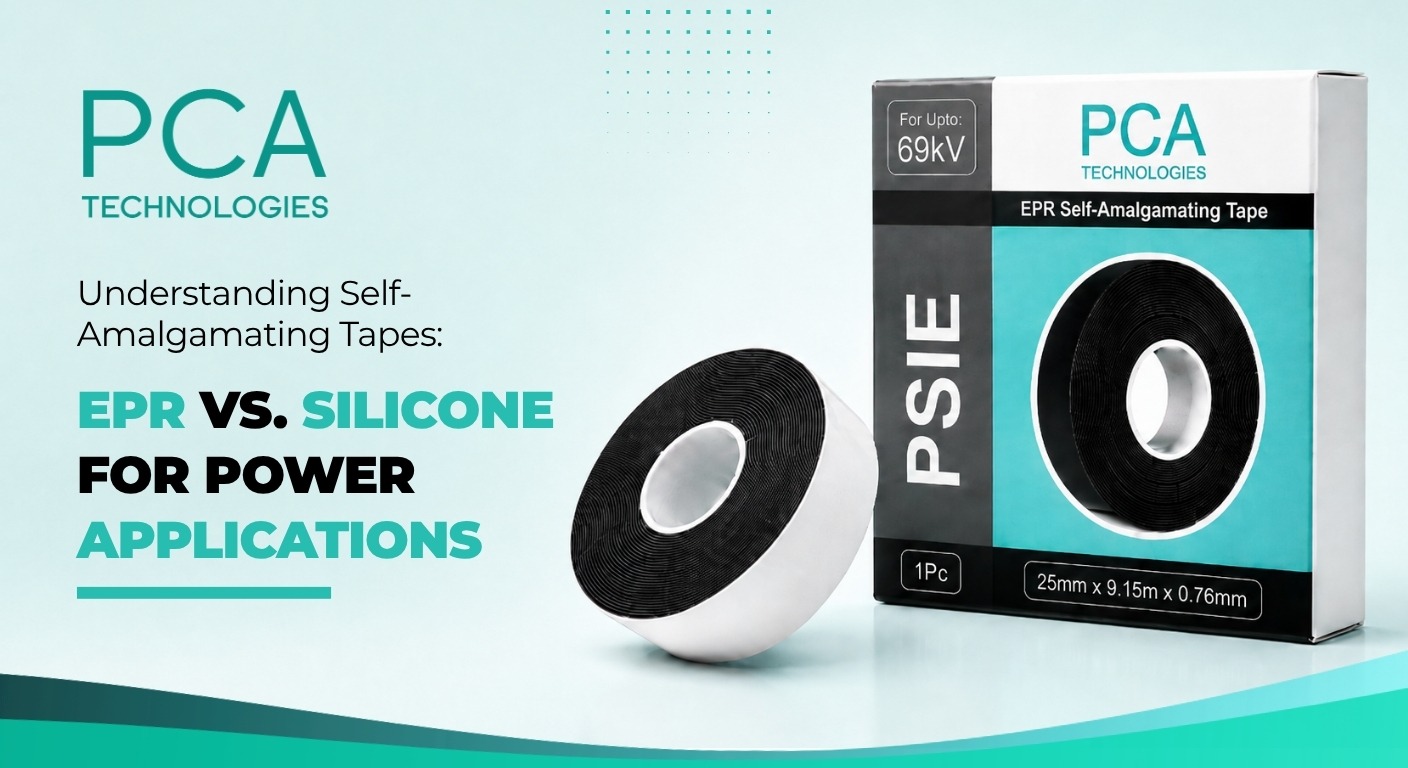
Electrical insulation in power cable systems must do more than simply cover a conductor. It may need to withstand electrical stress, moisture, heat, ozone, surface tracking, mechanical movement, and long periods of outdoor exposure.
This is where Self Amalgamating Tape becomes useful. Unlike conventional adhesive tape, it bonds to itself when stretched and wrapped correctly. The overlapping layers gradually combine into a continuous rubber like mass. This creates a tight insulation and sealing layer without relying on a conventional adhesive coating. Self amalgamating tapes are commonly manufactured using materials such as EPR and silicone.
For power engineers and cable jointers, however, choosing between HT EPR Tape and Silicone High Voltage High Temperature Tape requires an understanding of what each material is designed to handle.
A Self Amalgamating Tape is designed to fuse with its own surface when it is stretched and overlapped during installation. Because there is no conventional sticky adhesive layer, the material can form a relatively uniform insulation barrier around cables, joints, connectors, and irregular components.
This property is valuable in electrical applications because air gaps and moisture paths inside insulation systems can weaken long term reliability.
The tape can conform around cable insulation, connectors, lugs, joints, and changes in diameter. Depending on its material and electrical rating, it may be used for primary insulation, moisture sealing, cable repair, padding, and environmental protection.
PCA Technologies lists both Self Amalgamating EPR Tape for HV insulation and Self Amalgamating Silicone Tape within its insulation enhancement and sealing range.
HT EPR Tape uses Ethylene Propylene Rubber as its main insulating material. EPR is widely used in electrical insulation because it combines flexibility with good dielectric performance.
A typical electrical grade EPR tape is highly conformable. It can be stretched during installation and wrapped around complex cable profiles. Comparable EPR splicing tapes are used for insulation of solid dielectric cable joints at voltage classes reaching 69 kV, subject to the product specification and approved joint design.
The material is particularly useful when insulation thickness must be reconstructed around a joint.
Consider a cable joint where the original insulation has been removed during conductor preparation. The jointer must rebuild the insulation system around the connector. Several controlled layers of EPR tape can create a smooth insulation profile while reducing internal gaps.
EPR tape can also support moisture sealing around electrical connections. Its flexibility allows the material to follow changes in cable diameter without leaving large unsupported spaces.
A Silicone High Voltage High Temperature Tape has a different strength profile.
Silicone rubber performs particularly well where elevated temperature, ozone, weather exposure, arcing, and electrical tracking are important design considerations. Electrical grade silicone self fusing tapes are available with high dielectric strength and strong resistance to arc and track activity. Some products are designed for continuous operation at temperatures reaching 180°C.
PCA Technologies states that its Self Amalgamating Silicone Tape is suitable for applications up to 69 kV and is intended for insulation, weatherproofing, mechanical padding, cable repair, and protection of electrical components. The product is also described as having strong UV resistance for outdoor and indoor use.
This makes silicone particularly useful around exposed terminations, outdoor cable accessories, high temperature equipment, and locations where surface electrical stress may occur.
The correct choice depends on the function the tape must perform.
Design Requirement | HT EPR Tape | Silicone Tape |
Primary insulation build up | Very suitable | Suitable when specified |
Cable splice reconstruction | Common application | Application dependent |
Moisture sealing | Strong capability | Strong capability |
High temperature exposure | Good | Excellent |
Ozone and weather resistance | Good | Excellent |
Arc and tracking resistance | Product dependent | Major advantage |
Irregular cable profiles | Highly conformable | Highly conformable |
Silicone should not automatically replace EPR simply because it has better temperature resistance. Cable insulation systems are engineered as complete assemblies. Material compatibility, electrical stress control, required insulation thickness, cable type, joint design, and manufacturer instructions must all be considered.
Likewise, EPR should not automatically be selected for every splice simply because it builds insulation efficiently.
Understanding how to use self amalgamating tape is as important as choosing the correct material.
The surface should first be clean and prepared according to the cable accessory procedure. Contamination, oil, loose particles, and unnecessary moisture should be removed.
The release liner is separated gradually as the tape is applied. The tape is then stretched according to the manufacturer instructions and wrapped under controlled tension.
Many applications use approximately half overlap between successive turns. This means each new wrap covers a significant portion of the previous layer. Comparable self amalgamating tape guidance recommends controlled stretching and overlapping to encourage proper fusion.
Tension must remain reasonably consistent throughout the application. Excessive stretching can reduce the final insulation thickness. Insufficient stretching may prevent the tape from conforming properly.
Transitions should also remain smooth. Sharp changes in profile can create weak locations in an insulation system.
Choosing between EPR and silicone starts with the actual operating environment.
For rebuilding insulation around a power cable splice, HT EPR Tape may be the logical choice when specified by the joint design.
For exposed equipment where heat, ozone, surface tracking, UV exposure, and weathering dominate, Silicone High Voltage High Temperature Tape may provide significant advantages.
The most important principle is that tape selection should follow the cable voltage, insulation material, accessory design, operating temperature, environmental exposure, and approved installation procedure.
A Self Amalgamating Tape may appear simple, but in a power system its performance depends on material chemistry, electrical stress, correct tension, overlap, and installation quality.
Need the right insulation tape for your cable application? Connect with PCA Technologies for expert guidance and reliable cable accessory solutions.
Self Amalgamating Tape is commonly used for electrical insulation, moisture sealing, cable jointing, cable repair, weather protection, and wrapping irregular electrical connections.
Yes. Electrical grade EPR tapes are available for high voltage insulation and jointing applications. The exact voltage capability must always be verified against the product specification and cable joint design.
EPR tape is widely used for insulation build up and cable splicing. Silicone tape offers strong performance where high temperature, ozone, weathering, electrical tracking, and arcing resistance are important.
Many applications use approximately half overlap between successive wraps. However, the required stretch, overlap, and number of layers should always follow the product and accessory installation instructions.
Yes, provided the selected tape is designed for outdoor service. Silicone tapes are particularly useful where UV, ozone, temperature, and weather exposure are significant.
Contact us now by filling out the form or drop us an email. And we’ll get back to you as soon as possible.
© PCA Technologies Private Limited – 2026